A maintenance manager at a food processing plant once told me his site had passed two OSHA audits in a row. Their 1910.147 programme was clean. Procedures in place, training records current, annual inspections signed off. Six months later, an electrician working on a 480V MCC took an arc flash to the face shield during a lock application. The incident investigation traced it back to a procedure that never required phase-to-ground voltage testing before the isolation was declared safe. The facility was not fined under 1910.147. They were fined under the [General Duty Clause](https://www.osha.gov/laws-regs/oshact/section5-duties) for failing to follow NFPA 70E - an industry consensus standard they had never formally adopted.
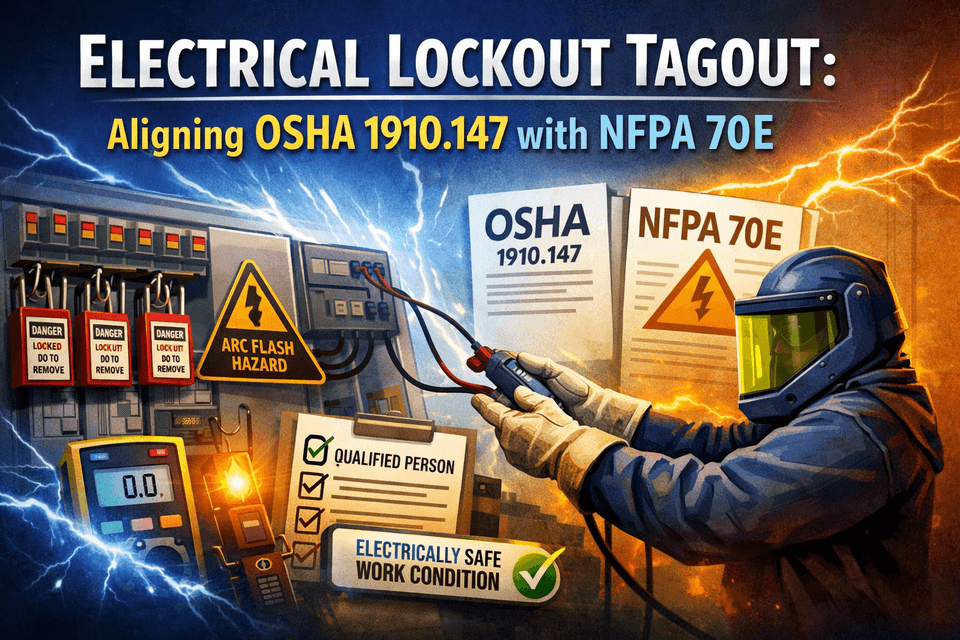
This is the problem with electrical lockout tagout. OSHA's general LOTO standard is enforceable federal law, but it was not written specifically for electrical hazards. NFPA 70E fills the gap - and OSHA cites it constantly. A compliant electrical LOTO procedure has to satisfy both.
Most digital LOTO tools treat electrical work the same as any other energy type. At Zentri we took a different view. Our procedures let you capture the NFPA 70E-specific fields that a 1910.147 template tends to miss - voltage class on the machine record, an explicit live-dead-live voltage verification step, and the arc flash and qualified-person requirements written into the procedure itself rather than sitting on a separate label or training matrix. This article walks through where the two standards diverge and what a procedure needs to carry to satisfy both.
## Why Electrical Lockout Tagout Sits Between Two Standards
[29 CFR 1910.147](https://www.osha.gov/laws-regs/regulations/standardnumber/1910/1910.147) is broad by design. It covers hazardous energy generically - electrical, hydraulic, pneumatic, thermal, mechanical, chemical, and gravitational. The standard tells you to isolate, verify, lock, and train, but it rarely drills into the specifics of any single energy type. Electrical work is where that generic approach starts to break down.
NFPA 70E, the [Standard for Electrical Safety in the Workplace](https://www.nfpa.org/codes-and-standards/all-codes-and-standards/list-of-codes-and-standards/detail?code=70E), is the consensus document that fills those gaps. Article 120 of NFPA 70E 2024 gives you electrical-specific lockout procedures, approach boundaries, arc flash calculations, and a structured process for establishing what the standard calls an Electrically Safe Work Condition (ESWC). OSHA does not enforce NFPA 70E directly, but inspectors routinely reference it to establish the recognised industry practice, and the General Duty Clause gives them the citation authority to act on it.
For anyone writing a LOTO procedure that involves electrical isolation, the question is not which standard applies. Both do.
## OSHA 1910.147 vs NFPA 70E: What Each Standard Actually Requires
The two standards overlap on the basics and diverge on the specifics. OSHA 1910.147 requires an energy control programme, machine-specific procedures, authorised employees, periodic inspections, and documented training. NFPA 70E Article 120 adds the electrical-specific layer: test equipment requirements, phase-to-phase and phase-to-ground verification, the concept of an Electrically Safe Work Condition, and the classification of lockouts as simple or complex.
Where 1910.147 says "verify the isolation," NFPA 70E tells you exactly how - with a rated meter, tested on a known source before and after, across every phase conductor. Where 1910.147 is silent on arc flash, NFPA 70E 130.5 requires an incident energy analysis and defines the boundary at which PPE is mandatory. Where 1910.147 treats every lockout the same procedurally, NFPA 70E 120.5 distinguishes between a single-source, single-worker lockout and a complex one involving multiple crews, energy sources, or work periods. If you want the longer comparison, [Safety+Health Magazine's breakdown of NFPA 70E and lockout/tagout](https://www.safetyandhealthmagazine.com/articles/25464-nfpa-70e-and-lockout-tagout) is a good starting reference.
The short version: if your electrical procedure only references 1910.147, you are compliant with one standard and exposed to the other.
## Qualified Person vs Authorised Employee: Why the Definitions Don't Overlap
This is one of the most misunderstood points in electrical LOTO. OSHA 1910.147 uses the term authorised employee - someone trained on the specific energy control procedure for the machine being serviced. NFPA 70E uses qualified person - someone who has demonstrated skills and knowledge related to the construction and operation of electrical equipment and can identify the hazards involved.
They are not interchangeable. An authorised employee trained to isolate a pneumatic press is not automatically qualified to lock out a 480V motor control centre. The training, the hazard recognition, and the verification methods are different.
I spoke with a plant maintenance supervisor last year who had twelve authorised employees signed off on LOTO. Only three of them met the NFPA 70E definition of a qualified person for medium-voltage work. When one of the other nine was asked to lock out a 13.8kV switchgear, the procedure on paper said he was authorised. The standard said he was not qualified. The procedure did not flag the difference.
> **How Zentri handles this:** Zentri lets you record the qualified-person requirement as a field on the machine procedure itself, alongside the voltage class. The person executing the lockout sees the requirement before they start work, rather than having to cross-reference a separate training matrix. Role-based enforcement of qualifications is on our roadmap - for now, the platform makes the requirement visible and auditable where it matters: on the procedure document the electrician is actually following.
## Simple vs Complex Lockout: The 2024 NFPA 70E Classification OSHA Never Mentions
NFPA 70E 2024 Article 120.5 introduced a distinction that OSHA 1910.147 does not recognise: simple versus complex lockout. A simple lockout involves one energy source, one qualified person doing the work, and that person is in charge of their own lockout. No written plan of action is required beyond the standard machine procedure.
A complex lockout is anything that involves more than one energy source, more than one crew or craft, multiple locations, multiple employers, multiple disconnecting means, multiple work periods, or a particular sequence to complete. For complex lockouts, NFPA 70E requires a written plan of action, a group lockout/tagout device, and a single authorised employee assigned overall responsibility for the group.
OSHA's closest equivalent is group lockout under [1910.147(f)(3)](https://www.osha.gov/laws-regs/regulations/standardnumber/1910/1910.147), but the simple-versus-complex classification is specific to NFPA 70E. If your electrical LOTO procedures do not explicitly state which category each machine falls into, you are missing a step the 2024 edition now expects. Most static procedure libraries have never been updated to reflect this - and when facilities move their procedures onto a digital platform, the simple-versus-complex tag is one of the easiest fields to add and one of the most commonly missing.
## The Six-Step NFPA 70E Lockout Sequence (Where 1910.147 Stops Short)
NFPA 70E 120.4 prescribes the sequence for establishing an Electrically Safe Work Condition. The steps are: determine all possible sources of electrical supply, open disconnecting devices for each source, visually verify that blades are fully open or drawout circuit breakers are withdrawn, apply lockout/tagout devices, release stored electrical energy, and verify absence of voltage using an adequately rated test instrument.
OSHA 1910.147 covers most of these, but stops short in two places. First, the visual verification of disconnect position - you would be surprised how often a switch handle shows "open" when the contacts are welded closed internally. Second, the verification of absence of voltage, which 1910.147 describes as "verify the isolation" without specifying the method. NFPA 70E is prescriptive on both.
When we build a machine-specific procedure in Zentri, each of those six steps is a discrete, signable step the electrician works through rather than a single "isolated and verified" checkbox. The visual verification of blade position and the live-dead-live voltage test each sit on the procedure as their own captured sign-off, so the record shows which steps were completed and which were not.
## Test-Before-Touch: The Zero Voltage Verification Step Most Procedures Miss
If there is one step that makes the difference between a compliant electrical LOTO and a citation risk, it is this one. [NFPA 70E 120.6(7)](https://www.nfpa.org/codes-and-standards/all-codes-and-standards/list-of-codes-and-standards/detail?code=70E) requires that the absence of voltage be verified using a rated test instrument that has been checked on a known live source before and after the test. This is the live-dead-live method, and it applies to every phase conductor, phase-to-phase and phase-to-ground.
The reason for the before-and-after check is simple: if your meter fails during the dead test, you have no way of knowing whether the circuit is actually dead or whether your meter is. A few years ago, a Canadian electrical contractor I know had a fatality on a 600V feeder. The electrician pulled his meter, tested the conductor, got no reading, proceeded to work. The meter had failed internally between the last known-live source and that test. There was no "test the tester" step in the procedure. The investigation report was blunt: the procedure met 1910.147 but did not meet NFPA 70E 120.6(7).
A lot of electrical LOTO procedures in the field still read "verify de-energised" without specifying the method. That is the most common gap we see when manufacturers migrate their procedures onto Zentri. When we build an electrical procedure on the platform, the three-point test gets written in as its own captured sign-off - meter proofing on a known source, phase testing across the isolated conductor, meter proofing again. If a step is missed, the procedure record shows which sign-offs were captured and which were not.
## Arc Flash Boundaries During Lockout Application
The moment just before an electrical LOTO is complete - the moment the disconnect is operated and the lock goes on - the equipment is still energised. Operating a disconnecting means on energised equipment exposes the worker to arc flash. NFPA 70E 130.4 and 130.5 set out the approach boundaries and the incident energy analysis that determines the PPE requirement for that operation.
This is one of the places where a 1910.147-only procedure is legally compliant but not actually safe. The LOTO procedure tells the electrician to isolate the disconnect. It usually does not tell them what arc flash PPE is required during the isolation itself. That is an NFPA 70E requirement, and if the arc flash incident energy exceeds the PPE Category 2 threshold of 8 cal/cm², the procedure needs to call that out explicitly.
Arc flash labels on the equipment help, but they are not a substitute for a procedure that tells the worker what boundary they are entering and what PPE they are wearing when they do it. [OSHA's 2015 letter of interpretation](https://www.osha.gov/laws-regs/standardinterpretations/2015-08-05) makes clear that electrical lockout procedures need to account for the hazards during the application of the lockout, not just after. When we write electrical procedures in Zentri, we put the arc flash boundary and PPE category into the procedure itself, up front, as a required pre-work instruction. The worker reads it on the procedure they are already following, rather than having to turn away from the panel to check a label behind the cabinet door.
## Temporary Removal of Electrical LOTO for Voltage Testing
Sometimes the work requires a brief reenergisation - to verify a repair, to troubleshoot, to test a control circuit. [1910.147(f)(1)](https://www.osha.gov/laws-regs/regulations/standardnumber/1910/1910.147) allows this, with conditions: remove non-essential items, notify affected employees, conduct the testing, then re-apply the lockout. NFPA 70E 120.2(F)(2) aligns with this but adds specifics about how the test is conducted and what PPE is required during the temporary reenergisation.
Most electrical LOTO procedures do not document this scenario at all. If your procedure has no section covering temporary interruption for testing, you have two options: the electrician makes it up on the fly, or they skip the testing and miss the defect. Neither is compliant. We covered this in more depth in our guide to [temporary LOTO removal during testing and start-up](https://www.zentri.cc/resources/blog/temporary-loto-removal-managing-testing-and-start-up-safely).
## The Electrical LOTO Mistakes Auditors Flag Most Often
Across the electrical LOTO procedures we have reviewed, the same gaps keep showing up. Verification of absence of voltage written as "verify de-energised" with no method specified. Unqualified authorised employees assigned to electrical lockouts. Arc flash PPE referenced only in the site safety manual and not in the procedure itself. No provision for temporary reenergisation. No distinction between simple and complex lockouts per the 2024 NFPA 70E definitions.
These are the same failures that turn up in OSHA enforcement data and in arc flash incident investigations. We walked through the most common citation patterns in [10 Most Common LOTO Violations and How to Avoid Them](https://www.zentri.cc/resources/blog/oshas-top-10-most-cited-violations-in-2025-what-changed-and-what-it-means-for-your-plant) - the electrical-specific failures tend to cluster around verification and qualification, which is exactly what NFPA 70E is there to prevent.
## Writing One Electrical LOTO Procedure That Satisfies Both Standards
A compliant electrical LOTO procedure for a specific machine needs to carry more than the 1910.147 basics. It needs to name the qualified person role separately from the authorised employee role. It needs to list voltage ratings for every electrical energy source. It needs the six-step NFPA 70E sequence. It needs the live-dead-live voltage verification method written in, not referenced to a separate standard. It needs the arc flash boundary and PPE requirement for the disconnect operation. It needs to be classified as simple or complex per 120.5. And it needs a temporary reenergisation protocol if the scope of work ever requires testing.
This is a lot to carry on a paper procedure. We covered the general approach in [How to Write a Machine-Specific LOTO Procedure](https://www.zentri.cc/resources/blog/how-to-write-a-machine-specific-loto-procedure-step-by-step), but the electrical overlay adds a layer that most static templates were not designed for.
This is where Zentri earns its place in an electrical LOTO programme. Every electrical procedure on the platform can carry the NFPA 70E layer inside the same digital document the electrician is already following: voltage class captured on the machine record, the six-step ESWC sequence broken out as discrete signable steps, a dedicated live-dead-live voltage verification sign-off, and fields for the arc flash boundary, PPE category, qualified-person requirement and simple-versus-complex classification written into the procedure itself. The electrician does not have to remember the standard - the procedure is already built against it.
The standards are not going to merge. But your procedure can.
> ### See it in practice
>
> Zentri's digital LOTO platform lets you write NFPA 70E and OSHA 1910.147 into a single procedure your team actually follows on the floor. Book a walkthrough to see how voltage class, live-dead-live sign-off, arc flash PPE, and the qualified-person requirement sit together on a real machine procedure.
>
> **[Request a demo at zentri.cc →](https://zentri.cc)**
## References and Further Reading
- OSHA. [29 CFR 1910.147 - The Control of Hazardous Energy (Lockout/Tagout)](https://www.osha.gov/laws-regs/regulations/standardnumber/1910/1910.147)
- NFPA. [NFPA 70E - Standard for Electrical Safety in the Workplace](https://www.nfpa.org/codes-and-standards/all-codes-and-standards/list-of-codes-and-standards/detail?code=70E)
- OSHA. [Letter of Interpretation: Lockout/tagout of electrical hazards (August 2015)](https://www.osha.gov/laws-regs/standardinterpretations/2015-08-05)
- Safety+Health Magazine. [NFPA 70E and lockout/tagout](https://www.safetyandhealthmagazine.com/articles/25464-nfpa-70e-and-lockout-tagout)
- OSHA. [Occupational Safety and Health Act - Section 5, Duties (General Duty Clause)](https://www.osha.gov/laws-regs/oshact/section5-duties)
---